
Site Auditor
Every page, scored - and explained by AI.
A full-stack platform that crawls an entire website and grades it across SEO, performance, security, UX, AI visibility, and brand health - then turns raw findings into prioritized, plain-English recommendations.
- Role
- AI Specialist / Full-Stack Engineer
- Type
- SaaS Platform
- Stack
- Python · FastAPI · Playwright · LLMs · React
- Scope
- Crawling · Scoring · AI Insights · Outreach
- Live
- reviewmysite.app
01 - The Problem
Audit tools check one thing and dump a wall of metrics.
Most audit tools are single-purpose: one checks SEO, another checks speed, a third scans headers. Each hands back a pile of raw numbers and leaves you to make sense of it. Teams stare at a dashboard and still don't know what to fix first.
Worse, nothing explains why an issue matters or howto resolve it. A red metric is a symptom, not a plan. The gap between "here's a score" and "here's what to do Monday morning" is where most tools quietly give up.
And there's a brand-new dimension nobody was measuring. As AI search grows - LLMs citing sources directly in their answers - AI visibilityhas become a real traffic channel. If a model can't parse and cite your content, you're invisible in a place that didn't exist a year ago.
02 - The Crawler
A headless browser that walks the whole site.
The foundation is a Playwright-driven crawler that renders each page in a real headless browser - executing JavaScript so single-page apps and dynamically loaded content are captured exactly as a user (or a search engine) would see them.
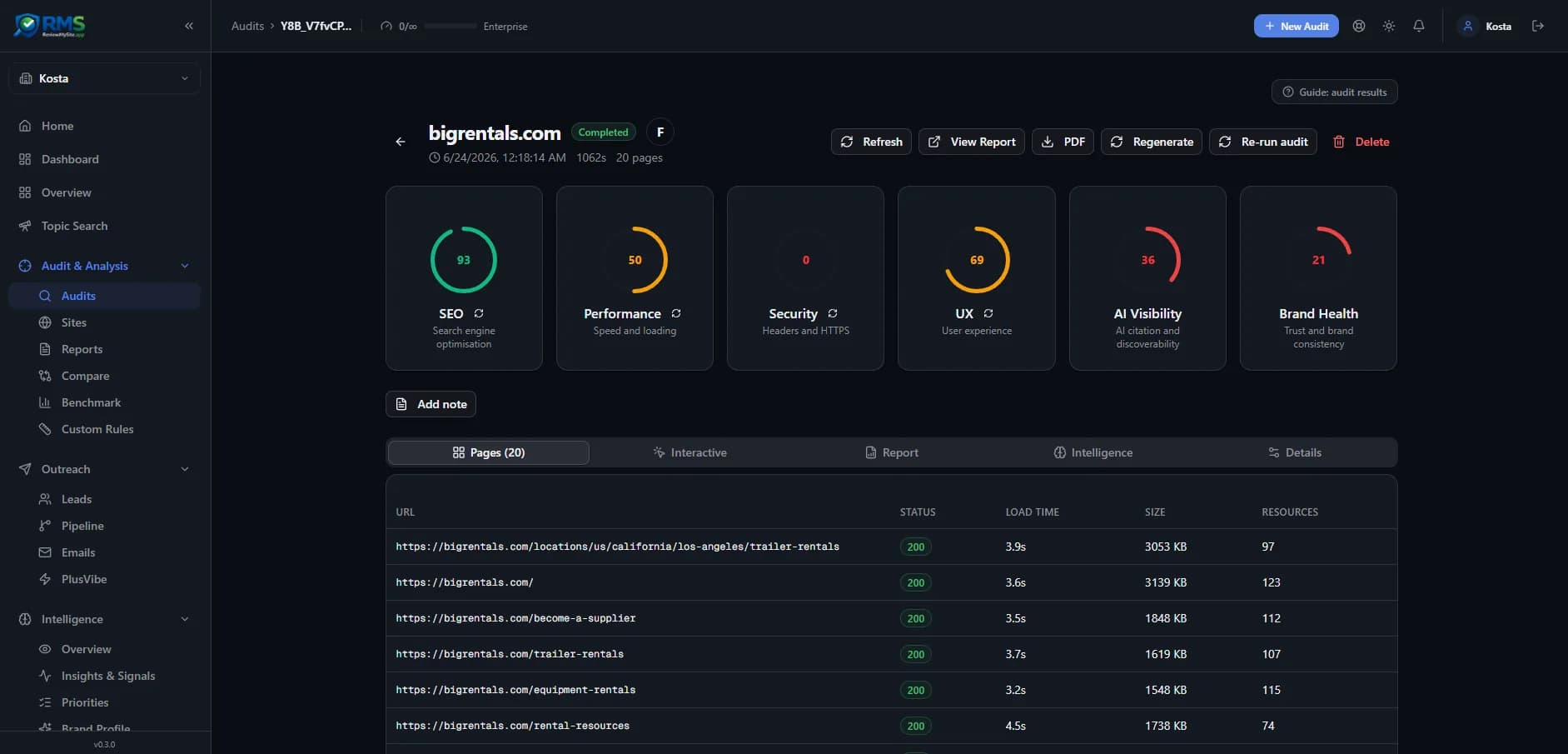
For every page it records HTTP status, load time, transferred size, and resource count. It's built to crawl 20+ pages per site, manage work through background workers with Celery so long audits never block the API, and persist every result in PostgreSQL for repeatable, comparable runs.
03 - Six-Dimension Scoring
One crawl, six independent scores.
Raw crawl data feeds six independent scoring engines. Each produces a 0-100 grade with color-coded severity, so a critical failure - like a security score of zero - stands out instantly instead of hiding inside a spreadsheet.
- i.
SEO
Meta tags, heading structure, canonical signals, sitemap and robots, and crawlability. Parsed directly from the rendered DOM so single-page apps are graded on what users actually see.
- ii.
Performance
Lighthouse-driven measurement of real loading behavior - render-blocking resources, payload weight, and time-to-interactive across the crawled pages.
- iii.
Security
HTTPS enforcement, security headers (CSP, HSTS, X-Frame-Options), and exposed-resource checks. A missing header set is exactly what drives a score to zerountil it's fixed.
- iv.
UX
Core Web Vitals and accessibility signals - layout stability, tap targets, contrast, and semantic structure - measured per page, not just on the homepage.
- v.
AI Visibility
The new axis. How citeable and discoverable the content is to LLMs - structured data, clear answer-shaped content, and machine-readable context that earns citations in AI search.
- vi.
Brand Health
Trust and consistency signals - naming, messaging, and presentation coherence across pages that shape how credible a site feels at a glance.
04 - AI-Powered Insights
The differentiator: findings that explain themselves.
A score tells you something is wrong. It doesn't tell you what to do. That's the job of the LLM layer - and it's what sets this platform apart from every metrics dashboard.
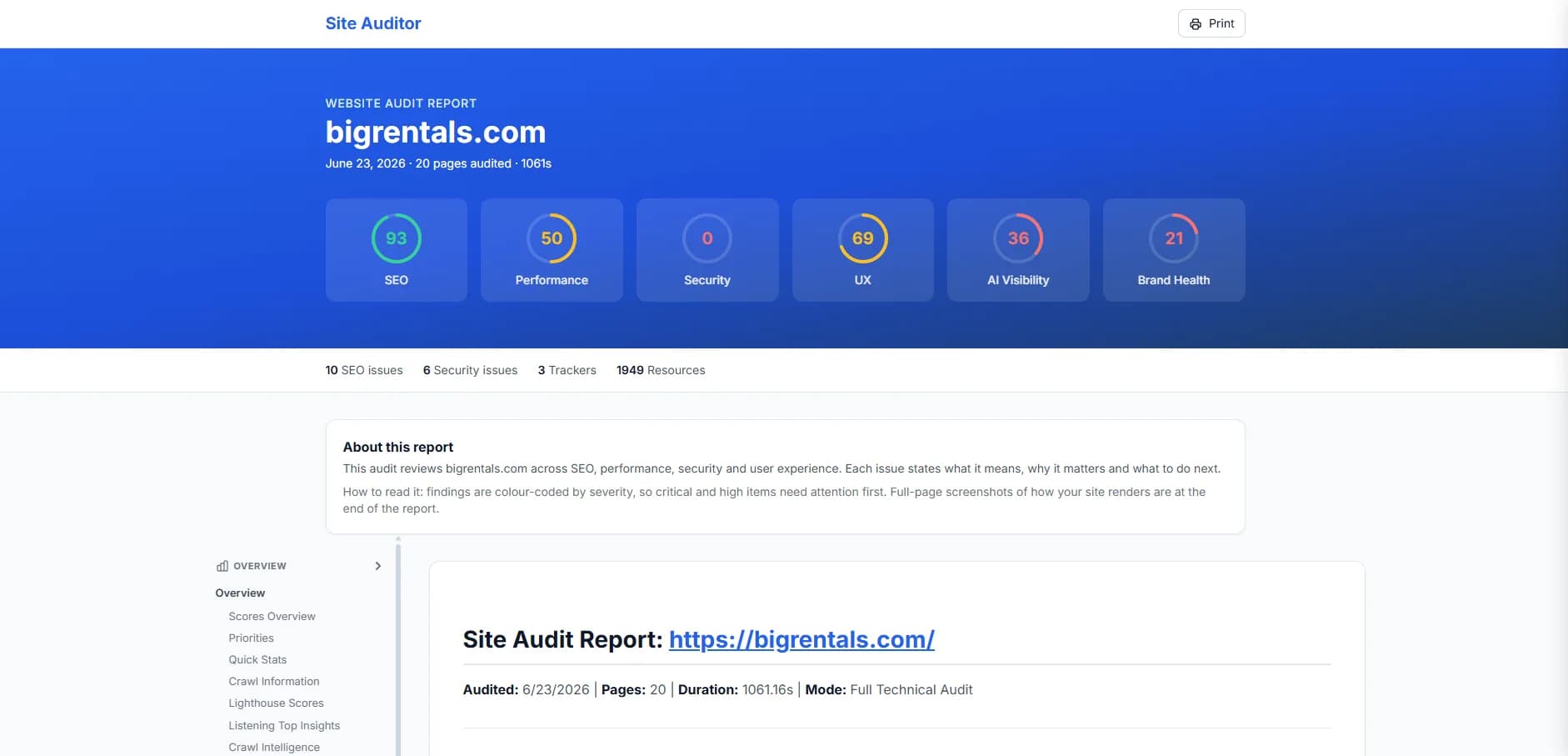
The model reads the raw findings across all six dimensions and produces a prioritized, plain-English report: what each issue means, why it matters for this specific site, and the concrete next action. Critical, high-impact fixes rise to the top; cosmetic ones sink. The output reads like advice from a senior consultant, not a log file.
05 - From Audit to Outreach
An audit is the start of a conversation, not a PDF.
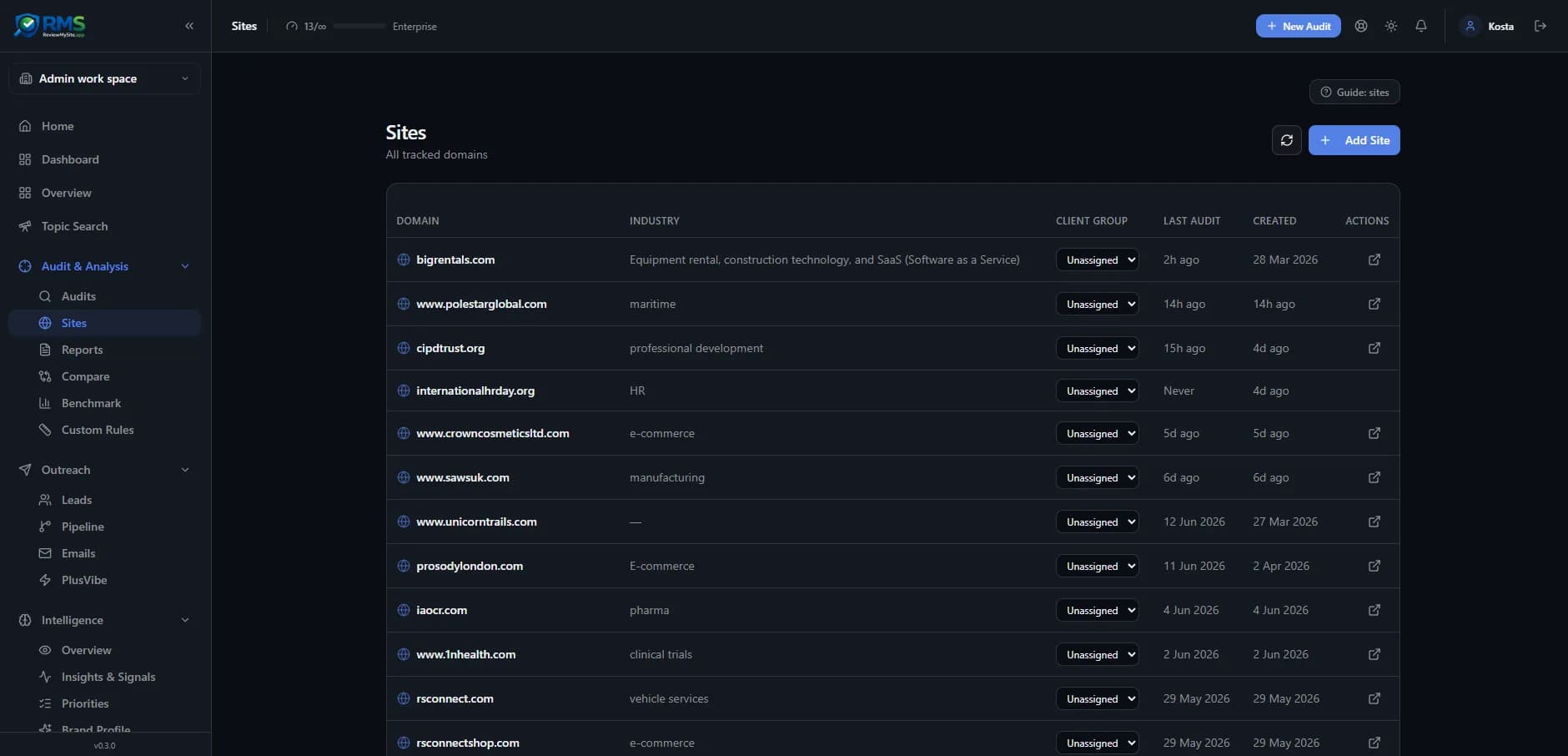
The platform doesn't stop at a single report. It tracks many domains at once - each with its industry, last-audit date, and history - and groups them so an agency or sales team can work a whole portfolio instead of one URL at a time.
From there, audits feed an outreach and intelligence layer that turns insight into action:
- Leads & Pipeline - every audited domain becomes a tracked record with industry, last audit, and stage.
- Insights & Signals - recurring issues surfaced across a portfolio of sites, not one at a time.
- Brand Profile - a synthesized view an LLM can reference to personalize outreach.
- Emails - findings turned into a concrete, specific opening message instead of a generic pitch.
- The result -
From URL to action plan in ~17 minutes.
One platform takes a bare URL and returns a prioritized action plan - 20 pages crawled in 1061 seconds, scored across six dimensions including the new AI-visibility axis, with AI explanations that make every finding actionable.
The hard part wasn't any single feature - it was making the whole pipeline reliable and repeatable. Crawling infrastructure that handles real, messy sites without falling over, and an LLM evaluation layer engineered to produce consistent, trustworthy output instead of plausible-sounding noise. That combination - dependable data plus genuinely useful explanation - is what turns an audit from a report into a decision.